Custom-built platform · Not WordPress

One custom platform for every location.

Canyon Edge is not WordPress. It is software we designed, built and launched for an organisation running a network of regional chapters, and it fits any business with franchises or storefronts. No themes to patch, no plugins to update: headquarters controls the brand, each location runs its own site, and every page is served from Cloudflare’s global network.

A chapter website published with Canyon Edge: navigation, a hero welcoming visitors to the chapter, calls to action and membership statistics.
Content blocks in the page builder
14
Page templates ready to use
13
Roles from platform admin to member
4
Backend calls to render a page
0

Why we built it

Forty locations should not mean forty WordPress installs to babysit.

Organisations with chapters, franchises or storefronts usually end up with one of two problems. Either every location runs its own WordPress site, with its own plugins, its own security holes and its own idea of the brand, or headquarters owns one site and every local update becomes a ticket.

So we did not reach for WordPress. We built Edge from scratch for exactly this shape of organisation, and launched it for a membership association and its chapters. Locations edit their own pages, events, news and forms in a shared admin, inside templates headquarters controls. Publishing pushes precomputed content to Cloudflare, so the public sites never wait on a database and keep serving through outages, deploys and maintenance.

Custom-built, not WordPress

Why we built Edge instead of a WordPress multisite.

Edge is not a theme, a page builder plugin or a hosted WordPress network. It is a purpose-built platform: a Laravel admin for your team and a SvelteKit site on Cloudflare Workers for your visitors, with nothing in between that needs patching.

Canyon EdgeTypical WordPress multisite
What it isCustom software built for multi-location organisationsA blogging CMS stretched across many sites with plugins
Plugins and themesNone. Every feature is part of the platformDozens, each with its own updates and vulnerabilities
When the backend is downEvery location keeps serving from the edgeEvery location goes down with it
Page deliveryPrecomputed and rendered on Cloudflare, near the visitorPHP and a database query on every uncached request
Location isolationEvery record belongs to one location and is checked on each accessDepends on plugin and network-admin configuration
Brand controlHeadquarters owns templates, blocks and theme; locations edit contentAny site admin with the right plugin can drift from the brand
Public attack surfaceOne scoped form endpoint; the admin is never in the request pathwp-admin, XML-RPC and every plugin endpoint on every site

What it does

Everything Edge handles for you.

Block page builder

Heroes, intros, services, team, FAQs, sponsors, plans, contact sections and live blog, news and event grids, arranged by drag and drop.

Custom domains, automatic SSL

Each location can have its own domains. Point a CNAME and Cloudflare issues the certificate, while the admin shows what DNS is still pending.

Edge-rendered, always on

Pages render on Cloudflare Workers from precomputed content. There is no database query per visit, and sites stay up if the CMS goes down.

Roles per location

Platform admins run everything. Location admins invite their team, editors manage content, and members get read-only access.

Lead forms that land

A row-and-column form builder, server-side validation, Cloudflare Turnstile and honeypot spam protection, with leads shown on each location’s dashboard.

Events, news & blog

Virtual, hybrid and in-person events with multiple dates, venues, registration links and tiered sponsors, plus news and blog with categories.

Product tour

Inside Canyon Edge real screens.

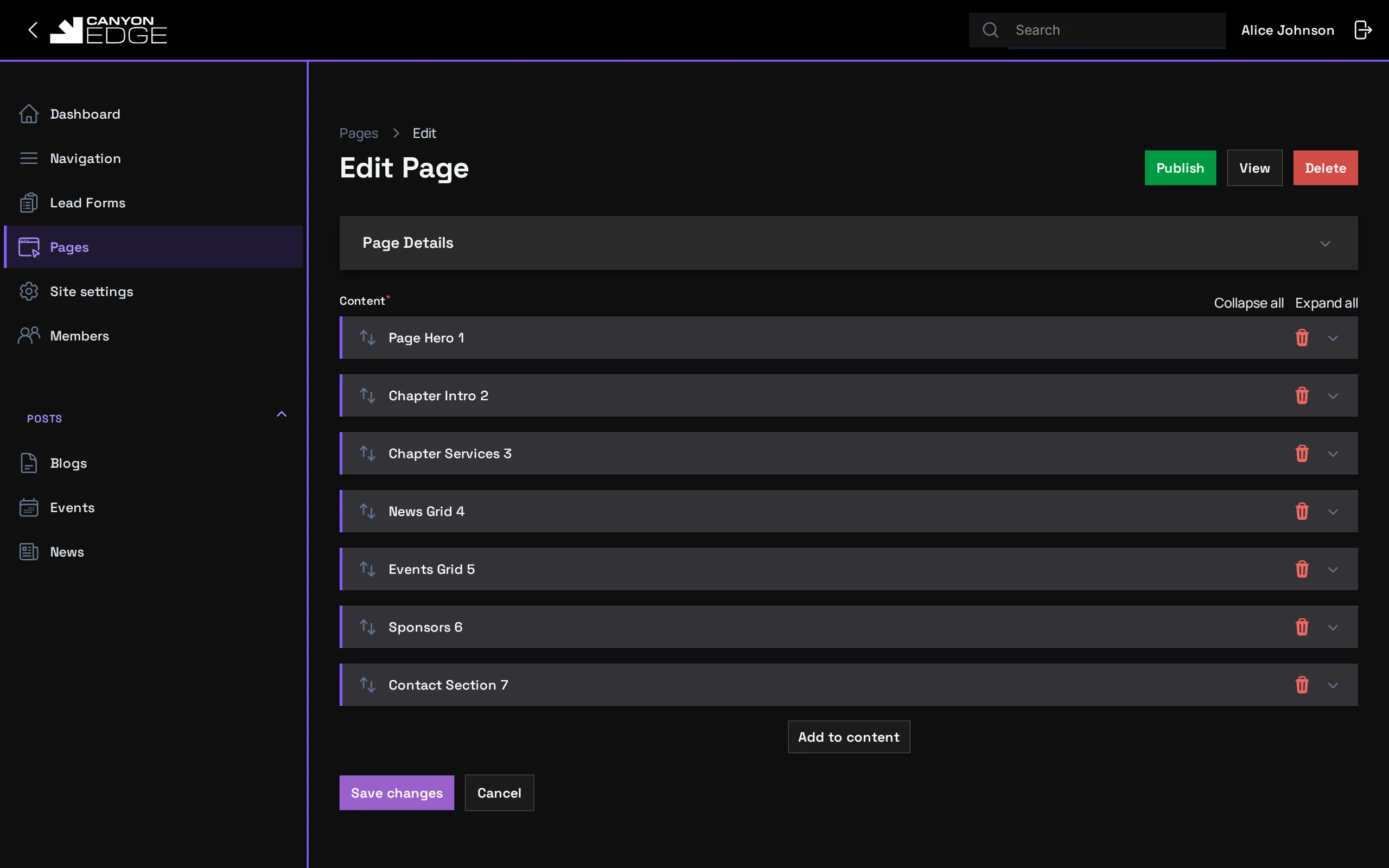
Canyon Edge page editor showing a chapter homepage built from ordered blocks (Page Hero, Chapter Intro, Chapter Services, News Grid, Events Grid, Sponsors and Contact Section) with a Publish button.

Page builder

Build a page from blocks, then publish

Location editors assemble pages from a library of branded blocks, reorder them, and fill them in with no code and no chance of breaking the design. Save and Publish are separate steps: saving keeps a draft, and publishing pushes that page to the edge.

  • 14 blocks, including live grids that fill from published posts and events
  • 13 page templates: homepage, events, membership, leadership, sponsors, FAQ and more
  • New locations start with 14 pages and 3 lead forms already created
  • Images converted to WebP and stored once, however many pages use them
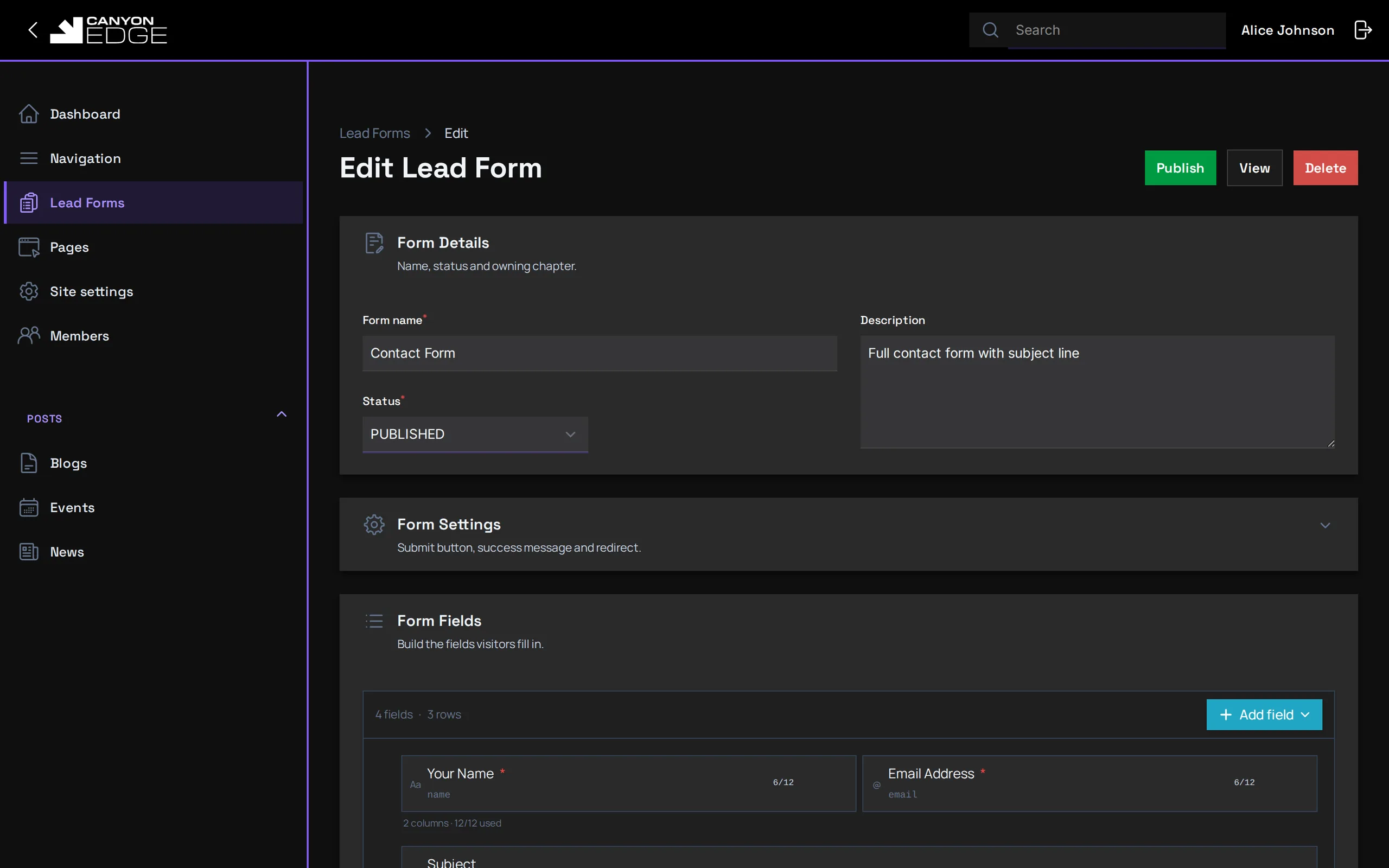
Canyon Edge lead form editor with form details, settings for the submit button and success message, and a drag-and-drop field grid with name and email fields.

Lead capture

Forms each location owns

Contact, event registration and quick-message forms are built on a grid of rows and columns, with required fields checked on the server as well as in the browser. A form only accepts submissions on the location it belongs to, and every lead is shown on that location’s dashboard.

  • Text, email, phone, select, date and more field types
  • Custom submit label, success message or redirect URL
  • Cloudflare Turnstile, a honeypot and a minimum time-on-page check
  • Per-form lead counts and a recent-leads feed

Under the hood

How it works.

Publish to the edge

Publishing writes each page, post and listing as precomputed JSON to Cloudflare R2, and maps every hostname to its location in Workers KV. The SvelteKit site on Cloudflare Workers reads that store directly, so a request is served near the visitor with no origin round trip.

Cloudflare WorkersR2Workers KVSvelteKit

Isolation between locations

Every record belongs to one location, and access is checked twice: what a person may do, from their role, and whose records they may do it to, both in lists and on each record. Published content is stored under each location’s own key prefix.

Tenant scopingRecord-level checksRole permissionsTested

Migrating an existing site

A scraper crawls a location’s old website into an import bundle that lands in the CMS as drafts, all or nothing, one location per file. Nothing goes live until someone reviews and publishes it.

Site importDraft-onlySlug-safeAll-or-nothing

Security & reliability

Built to be trusted.

Built with

  • SvelteKit 2
  • Svelte 5
  • Cloudflare Workers
  • Cloudflare R2
  • Workers KV
  • Cloudflare for SaaS
  • Laravel 13
  • Filament 5
  • Tailwind CSS 4

The CMS is not in the request path

Public traffic never reaches the admin or its database. The only live backend call is a lead-form submission, scoped to the location it came from, so the attack surface is a fraction of a typical CMS.

Up through outages and deploys

Because sites read content already published to the edge, an admin outage, database maintenance or a backend deploy does not take a single location offline.

Central control, local freedom

Headquarters owns the templates, blocks, starter pages, roles and theme. Locations change their own content and navigation inside those rails.

Crawlable by default

Pages are server-rendered HTML with clean slug URLs and fast delivery, so search engines see the full content without running any JavaScript.

Canyon Edge questions

What is Canyon Edge?
Canyon Edge is a custom multi-tenant website platform Canyon designed and built for organisations with many locations, such as associations with chapters, franchises and multi-storefront businesses. Each location gets its own website and admin access. Everything is managed from one admin and served from Cloudflare’s global network.
Is Canyon Edge built on WordPress?
No. Edge is custom software, not WordPress or any other off-the-shelf CMS. The admin is a Laravel application and the public sites are SvelteKit on Cloudflare Workers, so there are no themes or plugins to patch and no WordPress admin exposed on any location’s site.
What happens to our sites if the CMS goes down?
They keep serving. Published content is precomputed and stored on Cloudflare, and the public sites read it directly, so the CMS is not needed to render a page. Only new lead-form submissions depend on the backend.
Can each location use its own domain?
Yes. A location can have one or more custom domains. You add a CNAME record, Cloudflare issues the SSL certificate automatically, and the admin shows which domains are live and which are still waiting on DNS.
Can one location see or edit another location’s content?
No. Every record belongs to a single location, and permissions are checked for both what a person may do and which location’s records they may touch. Only platform administrators work across locations.
Can you move our existing chapter sites over?
Yes. We crawl each existing site into an import bundle, which lands in Edge as drafts for that location. Your team reviews and publishes, so nothing goes live by accident.
Is Canyon Edge sold as a subscription?
Edge is delivered as a Canyon engagement: we configure the platform for your brand, migrate your locations and run it for you. Get in touch to talk through your locations and timeline.

See Canyon Edge on your own setup.

Tell us about your sites, locations or inboxes. We will walk you through the platform and give you a straight answer on fit, timeline and cost.